The Unseen World of NDT
An intriguing insight into the world of NDT. This fact-finding video shows interesting facts on what goes on behind close doors and on the field…

An intriguing insight into the world of NDT. This fact-finding video shows interesting facts on what goes on behind close doors and on the field…
I finished last month’s column by referring to what many people think will revolutionise everyday life in the next few decades: Artificial Intelligence (AI). In fact, it is claimed that AI will match human intelligence by 2045. AI has been around for a number of years. In 1997, Garry Kasparov was beaten in a game of chess by a computer and since then the increases in computing power have enabled large quantities of data to be analysed, patterns to be extracted and solutions to be derived.
Recently, AI has captured people’s interest. Two film releases, Ex Machina and Her, have the human/machine interface central to their plots. Driverless cars have been in the headlines. At the beginning of March, AlphaGo, a computer programme, beat the world’s number one ‘Go’ player at the board game. This was seen as a big leap forward for AI. Back in 1997, the chess-winning algorithms would examine every permutation, looking many moves ahead, and then chose the one with the highest probability of winning. Go has many more possible moves than chess and, even with today’s processing power, it is not appropriate to use this approach. Instead, neural networks are used to allow the computer to learn by analysing the matches of the best human Go players and then to refine this learning further by playing against itself. AlphaGo was designed by a British company, DeepMind, which was bought by Google as part of its investment in AI.
The success of AlphaGo was heralded as a new beginning in AI: if a computer can teach itself to be superior to humans at Go, then what is there to stop it from being superior at everything else? It didn’t take long for a reality check to gatecrash the party. Later in March, Microsoft launched a tweeting ‘chatbot’ called Tay, built to speak like a teenage girl. Over the course of interactions with the public, Tay was designed to learn how to speak like a human. Unfortunately, it learnt from the wrong people and had to be taken offline because it was becoming too racist and sexist.
This highlights a potential Achilles heel of the neural network approach. As is the case with humans, it is only as good as the quality of the information it uses for learning and this can be beaten by the unexpected. In the case ofTay, the developers had made a presumption about how the public would respond and hence on the content that would allow Tay to learn. With hindsight, many observers pointed out that the actual response was not unexpected, with the Daily Telegraph quoting a professor from Bristol University as saying: “Have you seen what many teenagers teach to parrots?” Google’s DeepMind AlphaGo learnt from the best humans and from playing itself and was said by observers to generate creative moves in particular situations. When human Lee Sodol won the fourth game, he did so by playing what was referred to in Go terms as a ‘divine move’ – a truly inspired, non-obvious original move. AlphaGo was also defeated by the unexpected. Opinion on AI is split into two camps: the optimists who see all the potential applications, with AI removing the need for humans, and the pessimists, who warn that AI could take over and be the downfall of the human race. For the time being at least, AI still needs a helping hand from a human. At the end of April this year, Tim Peake, the UK’s astronaut on the International Space Station, remotely manoeuvred a robot rover over a simulated Mars terrain and cave located in Stevenage. The rover has the ability to plan its own route over a surface and to steer itself. However, it finds it difficult to cope with shadows created by craters and caves and so it is more efficient to have human input.
It does not take a great leap of imagination to envisage AI encountering similar difficulties in the analysis of NOT data, with the sudden appearance of the unexpected. Equally, it is possible to see the benefits that AI could bring in assisting the operator to sift through large amounts of data and providing the operator with sufficient information on which to make a final decision. Back when Kasparov was beaten, it was possible to examine the process through which the computer arrived at its decisions. Today’s AI systems undertake their own learning and it is much more difficult to follow the process that generates the solution they spit out. For critical safety judgements, it may not be the best idea to rely on a decision when the basis for that decision is not known. In his book Team of Teams: New Rules of Engagement for a Complex World, General Stanley McChrystal said that: “As complexity envelops more and more of our world, even the most mundane endeavours are now subject to unpredictability …” AI is coming to NDT, but the human operator will be sticking around for a long time to come.
First published in NDT News, a newspaper published by the British Institute of Non-Destructive Testing (BINDT) and also included on its website (www.bindt.org). Re-published here with the kind permission of BINDT and the author. Subject to copyright, © 2016. All rights reserved.
mcgrathfw@amec.com

Level II NDT Inspector and owner of NDT and Inspection Solutions (NIS), Jannie de Beer shares a challenging yet amusing obstacle many faced in NDT before technology got the better of us. Jannie’s experience in NDT dates back to 1989 when he was a Radiographer at the Matimba Power Station in Ellisras. He is now a Level II Inspector with experience and qualifications in the four conventional NDT methods; Magnetic Particle Testing ( MT), Ultrasonic Testing (UT), Liquid Penetrant Testing (PT) and Radiographic Testing (RT)…
Pin-hole photography was an experiment tried and tested by many Radiographers years ago, before digital cameras and in times when economies were not strained as they are today. How many radiographers of today have tried to take a pinhole photograph? Back in the day, before digital cameras and smart phones that can take countless instant photographs were developed, a pinhole camera made with a cardboard box could be used to photograph objects around us.
The lens of the camera was made by cutting a 50mm hole in the box and closing it with a black (exposed) radiograph and then making a pinhole in this black exposed radiograph to ensure light was emitted only though the little hole. The pinhole was closed with another piece of exposed black film to act as the shutter. The camera was then ready. In the darkroom, an unexposed radiographic film was placed in the box opposite the camera lens (pinhole) at a slight curve. The box is made light tight before taken out of the darkroom.
The camera was crudely aimed at an object and the shutter then opened. Depending on the strength of the sunlight, the exposure time for the picture could be between 10 and 40 minutes. At this point the camera should not be moved, the same would apply if taking a selfie. The best results were obtained when doing hand developing and the density adjusted manually by longer or shorter time in the developer.
The result was a “negative” of the object the same way as was possible with a conventional camera at the time.
‘Age Old Techniques of ‘Pinhole Photography’
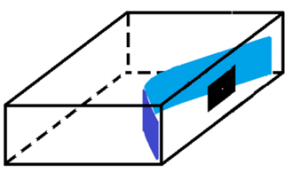
Drawing of the Inside of a Pinhole box

A modern take on pinhole photography
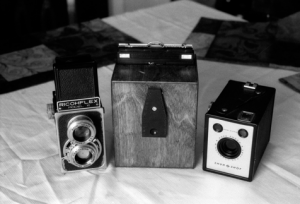
The antiques of photography

Inside look of an actual Pinhole Box

One of the main reasons I embarked on a career in NOT, and why I have enjoyed many years in the profession, is the variety of technical disciplines that need to be addressed and the variety of applications encountered. However, the range of non-technical aspects pales into insignificance when compared to the variety that human factors introduce into NOT. Within a nominally homogeneous group of operators, similarly trained and qualified and working with the same technique in the same profession, each individual applies a different set of skills, experience and thought processes.
I am reminded of this variability on a daily basis with respect to memory. My memory works in such a way that I am good at remembering faces, but I am not so good at remembering names. Both of these traits can lead to embarrassing situations: the former when I went to say hello to someone I thought I knew but remembered, just in time, that I only saw him on a regular basis working in the office behind the bank counter and had not actually had any contact with him; the latter, well you can imagine the embarrassment that can cause! In a similar vein, there are events in the past of which I have no recollection, whilst I have clear, distinct and persistent memories of certain moments of no particular importance.
One such moment happened many years ago as I was travelling south on the M6. The motorway was as clear as the M6 can be and I was able to glance at the undulating countryside next to the motorway. I looked at the trees and could clearly see the individual leaves with their crenated edges. My recollection of my thoughts at the time is as clear as my memory of the place and situation. “Human eyes are amazing. I can see detail on a leaf. I can see the multitude of leaves on the tree. That alone is a lot of information to be able to receive and process. However, I am travelling at 70 mph with an angular field of view and the scene I am looking at is changing rapidly. I am taking in and processing an incredible amount of information:’ it was a moment of wonder that has stayed with me.
Last week, whilst browsing in the airport bookshop, I glanced through a book I had referenced in this column in April 2015. Back then, I was championing the proof that humans cannot multitask. The title of the book is: The Organised Mind: Thinking Straight in the Age of Information Overload, by author and neuroscientist Daniel J Levitin. The moment I described in the previous paragraph took place after the black and white period, but pre-internet and wireless connectivity. These days, in addition to the information from the natural world, we have a lot more material goods and are bombarded with information from the virtual world. As the title suggests, the book describes how we can now be easily overloaded with information. We only have a limited amount of energy for processing information and it is important that we conserve it for the more important tasks. All the decisions we make use up neural resources and small decisions appear to use up as much energy as larger, significant ones.
When I go out running early on a Sunday morning, the bird song in the woods, though produced by many different birds, is clear, harmonious and enjoyable. Recently, whilst I was in the garden, a flock of birds in the trees squawked loudly and chaotically, which overloaded my aural system and was particularly annoying. I realised then that Twitter is well named. Occasionally, a series of tweets exhibits a certain quality of communication, but the vast majority just create a background noise that makes it hard to identify the tweets that are of interest.
As NDT professionals, we know all about signal-to-noise and the problems that poor signal-to-noise can cause when it comes to interpreting the data and extracting the key information. When trying to communicate, the noise not only distorts or hides the message, but it also uses up our limited mental resources. This makes it incumbent on all of us to consider what and how we want to communicate, be that in an email, in a procedure or in a software interface.
These days, when driving on the motorway, in addition to the natural environment described above and the increased volumes of traffic, we now have the overhead gantries contributing to information overload. ‘Junction 21,2 miles, 2 minutes’. What use is that? In two minutes you would know you are at Junction 21. Two minutes is not enough time to allow you to do anything in response to the information given! We could all benefit from following Gandhi’s advice: ‘Speak only if it improves upon the silence’
Please note that the views expressed in this column are the author’s own personal ramblings for the purpose of encouraging discussion within the NOT Newspaper. They do not represent the views of Amec Foster Wheeler or the HSE who funded the PANI projects. Letters can be mailed to The Editor, NOT News, Newton Building, St George’s Avenue, Northampton NN2 6)B. Fax: 01604 89 3861; Email: ndtnewseoindt.orq or email Bernard McGrath direct at bernard.mcgrath@amecfw.com
Bernard McGrath

 CEO- Non-Destructive Academy of South Africa (NASA)

Until only a few decades ago, women were subject to the then society norm of being associated with jobs supposedly best suited to their gender, thus reserving most technical career paths in the working world to men. Fortunately, times have changed, allowing stereotypes that separate men from women to largely fall away. South Africa’s engineering industry was male dominated until the 1940s, and has since evolved to enable more women to develop and exercise their technical abilities and expertise.
The South African Institute for Non-Destructive Testing (SAINT) is proud to host its first ever ‘Women in NDT’ conference in South Africa, taking place on 14 October 2016 at the Council for Scientific and Industrial Research (CSIR) in Pretoria.
“SAINT initiated this unique platform as a long awaited opportunity to acknowledge women NDT practitioners for their expertise and for the crucial role they play in the South African NDT industry,” says SAINT President Keith Cain. “The aim is to inspire, inform and recognise women in NDT – it certainly is a first in South Africa, and possibly in the world.”
“NDT has long been a predominantly male occupation, but this is changing rapidly; SAINT’s women members need to be recognised as worthy practitioners, hence this important day of inspiration and sharing of experiences by SAINT members,” says event Programme Director MC Elaine McDonald. “We want to encourage women to reach for higher goals in NDT. Many of them face unique challenges in the industry such as discrimination.”
A study carried out by University of Cape Town (UCT) student Kathryn Wooldridge shows that women in the South African engineering industry working at the same levels as men tend to receive lower salaries than their male counterparts. Another challenge faced by women in the engineering industry is finding a balance between the responsibilities of family and work. Kathryn Wooldridge is one of several exciting speakers who will address delegates at the conference.


“I expect this day to motivate and inspire women in NDT, not only on an inspection level but also on an administration level,” says Thea Wagner, Senior Sales Representative at Gammatec, and a member of the Women in NDT Day Organising Committee. Wagner will provide more information on Ultrasonic and Radiographic Testing and the impact these testing methods could have on pregnancy. “Women – We know our limitations and then defy them!” quips Wagner.
“SAINT is extremely proud to be hosting not just a day of inspiration, but an opportunity to honour these women that work hard to make a difference,” concludes Cain.
For more information visit: www.saint.org.za,SAINT Facebook