



Inspector Eish
Written by Keith Cain.
Eish has some tips for UT:
Envisage what you are seeing below the inspection surface .
Know the variations of material’s grain structure that you could encounter.
How important are DAC curves to you?
Keep all equipment stored in a suitable bag or container as probes like to hide themselves when you need them most.
Always have a tin of solvent pre-cleaner and rags with you. They can make a difference in improving scanning speed, lessening probe wobble and probe direction i.e. acquire a clean surface.
Memo to Techs – No. 3
With our thanks to Hennie de Wet.
Memo to Techs – No. 3
Good day everybody.
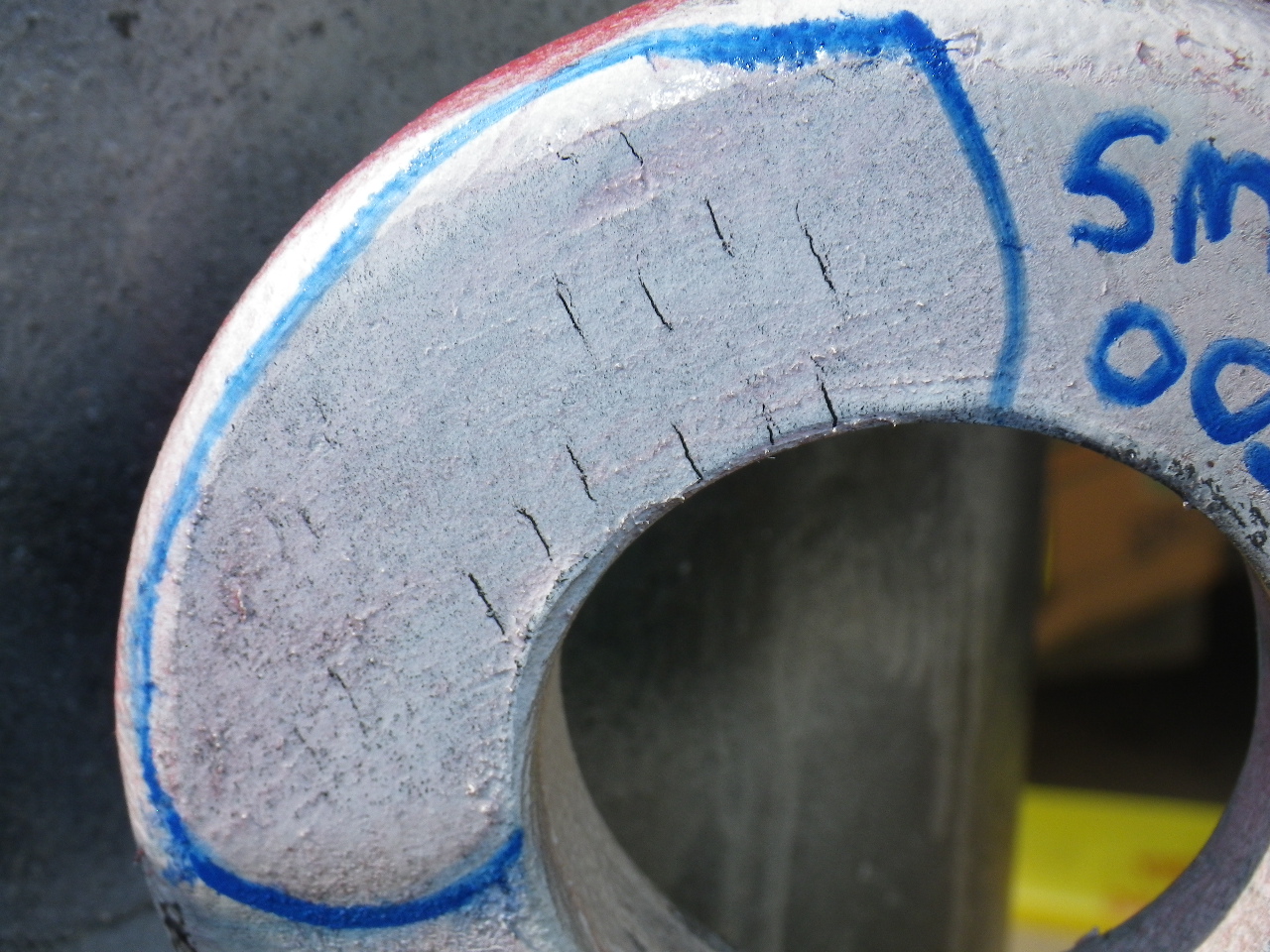
Penetrant testing is a relatively simple method and the practical application is basic, but it is the one method that is easily ruined.
Recently the client was not happy with the following statement on the report:
“Limited sensitivity due to the surface being corroded before the inspection.”
The client argued that the test surface was wire brushed before the PT inspection. True, but any cracks open to the surface would have been filled with corrosion. No amount of wire brushing will remove corrosion from a crack.
This is only accomplished with proper chemical etching. A time consuming, dangerous and expensive exercise.
The only way to get reliable results is to perform the Penetrant Inspection soon after the weld is completed and before corrosion sets in.
A lack of control in the manufacturer’s workshop will inevitably lead to you being requested to test a corroded part with PT.
RECOMMENDATION
Ask the client if you can do MPI on the welds instead of PT. MPI has no problem finding cracks filled with corrosion or paint, and it is faster. Explain to the client why you would like to deviate from the procedure.
You may have to go through the whole exercise of getting a procedure drawn-up and the rest. But the end result is a test that will find all possible defects and you can sign off the report with confidence.
Thanks guys.
Keep up the good work.
Hennie de Wet
Inspector Eish
Written by Keith Cain.
Eish has some suggestions for standard equipment for NDT (in addition to method related equipment) :
• Putty knife/Paint Scraper
• Half round file
• Paintbrush or portable dustpan brush
• Chipping hammer
• Flat cold chisel
• Wire brush
• Tweezers
• Pocket knife
• Scissors

Influence of Fear
Our thanks to Bernard McGrath for sharing his “Musings” with us.
Looking in my rear view mirror, I did a double take. I have seen a number of odd dashboard ornaments, but two football boots sticking vertically upwards, with their orange soles facing forward, was a new one. Further glances in the mirror clarified the situation somewhat: a young person was slouched in the passenger seat with feet up on the dashboard. Nothing else was visible apart from mum, evidently driving to Saturday morning football practice. This immediately gave me a dilemma.
Some weeks earlier, there had been a safety moment at work which had described in grisly detail the horrific injuries likely to be received by a passenger whose feet were up on the dashboard when the airbag activated. This had an immediate effect on me and I sent e-mails to my offspring to make them aware and to ensure that they and any people riding in a car with them would not suffer the same fate. I know that it had a similar effect on my colleagues.
Hence my dilemma. Do I just ignore the car behind and carry on with my Saturday morning errand? Or do I stop the car and go and tell the lady driving that she shouldn’t allow her son, or daughter, to put their feet over the airbag? The weighing up of the pros and cons begins. If I stop, get out and approach the car behind, what sort of reception will I get? Will they listen to what I have to say or will they just tell me to mind my own business or worse give me verbal abuse? Of course, having had the safety moment, there was no real dilemma: the consequences of not stopping, albeit with a small probability, could have been life changing for the young person in the passenger seat of the car behind. Traffic lights, a short distance up the road, offered a non-dramatic opportunity for my intervention. Unfortunately, but somewhat to my relief, the situation was resolved, as the car behind turned off and disappeared down a side street before we reached the traffic lights.
A relatively trivial incident, which illustrates the influence that our basic human emotions have on our decisions. What should have been a simple, conditioned response of “you don’t want to do that”, was restrained by modest fear of how the message would be received. These emotions have developed over the centuries as evolutionary mechanisms to protect the species and they have been reinforced by our own experiences, as well as through the wider media. No doubt you will all be able to recall or have heard about incidents where interaction with a stranger has elicited an aggressive response.
I have previously written that the two main underlying drivers in business are fear and greed. This is obviously an over simplification, but it often bears scrutiny. NDT can be adversely affected by both these drivers, however, the impact of fear is probably the most clear cut. Back in January, I referenced a thesis by Casper Wassink who, in explanation for the long time it takes to get NDT products to market, identified that codes and standards play a role in keeping NDT conservative. It is easy to understand why, historically, NDT relied on codes and standards: capability assessment relied on empirical evidence and practical experience. So collecting this information from across industry and integrating it in a standard made perfect sense. This no longer applies. There are computer models for predicting performance in support of practical evidence and there are well established processes for probability of detection assessment, performance demonstration and inspection qualification in different industries and geographical locations. In my view, and I am open to be persuaded otherwise, the continued insistence on the production of codes and standards, before the adoption of new techniques and equipment, is based on fear: fear of not being able to use a standard as protection if a defect goes undetected; fear of not being able to claim the application of “industry practice”; fear of a company’s investment being subsequently used for the benefit of competitors.
Another key fear, which the NDT profession has to counter, is the fear that the NDT will find a defect, with the consequential problems that will bring. Once detected, every defect has to be dealt with but if an inspection can be avoided, everything can carry on as planned. The worries go away. Just as they did when the car turned into the side street. By being aware of how innate and powerful emotions influence what we consider to be cool, logical decisions, we can at least pause and wonder if they are leading us down the correct path.
Last month, I offered to provide evidence to support my ramblings on how behaviours prevail over technology. Well, you didn’t disappoint: despite the ease of submitting comments using 2018 technology, compared to that available in the earlier years of this column, there has been no increase in the number of comments received!
If you agree or disagree, please submit your views and comments to either myself or the editor. Next month I hope to provide evidence to support these ramblings.
Email: ndtnews@bindt.org or email Bernard McGrath direct at bernard.mcqrath@woodplc.com

Keith Cain
Q & A with SAINT President Keith Cain
Full Name
Keith Crichton Cain
Position
Owner of:
- Chimaera Inspection Services (NDT Service Provider and Level 3 Advisory)
- Kuzizwa Centre (NDT Experiential Learning)
Current President of SAINT
- What sparked your interest in NDT?
See Paragraph 2 below.
- How did you begin your career in NDT?
While serving in the Air Force, our Officer Commanding informed my colleagues and I that our Armament section was going to be de-commissioned. We were given a choice: transfer to the Army, to AFB Louis Trichardt or to the units’ NDT section. I chose the NDT section by default as I did not want to leave Pretoria and that we were also told that the chances were greater in finding NDT employment outside of the SAAF.
- Person who has the biggest influence on your life?
Our Creator and my wife, Annatjie.
- Person who has the biggest influence on your NDT career?
There have been those who I have regarded as my mentors and are now deceased: Graham Goodman, Lew Wells, Eric Guest and George Murray. There have been others in the past and many at present, young and not so young who are still influencing my career – technicians, Saint council members, Level 3’s, equipment/consumable suppliers, training school staff and my sons to name a few.
- What are your current qualifications?
ET, RT, MT, PT L2
UT L1
ASNT L3 MT & PT
ACCP L3 MT & PT
- Which method do you enjoy most and why?
Magnetic Particle: I have the most experience hours in MT! This method seems pretty straight forward and simple to apply at first, but there is always some sort of Achilles heel. Material permeability and the ensuring of sufficient field strength can prove to be quite challenging at times. ET is also very enjoyable and I wish that I could of have gained a lot more experience with it.
- What industries or sectors have you been involved in?
Varying degrees of Pre & In-service (welds, castings and forgings): Aviation, Power Generation, Petrochemical, Rail, Civil Construction, Mining, Packaging, Food and Beverage, Telecommunications, Automobile, Formwork, Lifting Equipment, Material Handling, HVAC and Transport.
- What major projects have you been involved in?
Sasol Wax, Sasolburg
Project Jaldi, SAB Rosslyn
Komati Power Station (RTS)
New Control Tower, Lanseria Airport
Furnace Rebuilds, Lonmin Platinum
4 x SASOL Shutdowns
- What are your biggest challenges in NDT?
One challenge is not knowing everything there is to know in NDT and allocating sufficient time for research and experimentation.
Another is convincing potential customers of the real value that proper NDT can bring to the party.
One more, is having to refrain from physically ‘correcting’ a person who thinks he has done a good NDT job when it is clearly evident that he had no idea of what he was doing or, shows no passion and respect towards NDT. Technicians who don’t read prescribed procedures, inspection speed freaks………
- Most humorous NDT incident that you can remember
Before I even started my career in NDT, as an armourer we had to checks hundreds of pistol slides for cracks. After we were shown how to use a MPI bench, a colleague adjusted the coil shot duration in order to enable us to inspect the slides in a shorter time (by shortening the duty cycle). Soon the cable-to-coil connector fastener started to glow bright red which then subsequently became fused to the bolt. The regular NDT guys weren’t impressed at all.
Another time we were asked to perform ET on a helicopter oil cooler turbine shaft while it was still attached to the ‘chopper. One of the flight engineers asked us to be exercise caution as we had apparently magnetised the entire aircraft during a previous visit.
- What legacy would you like to leave in the industry?
I would like to be recognised as one of the individuals who contributed towards the successful implementation and acceptance of the SAINT Professional Body with the ensuing Professional Designation of a NDT technician becoming the mandatory if not statutory requirement for all levels of NDT personnel in South Africa.
Hope for the future
It is my hope that NDT becomes widely known and utilised properly in South Africa as well as internationally. Poor quality of NDT workmanship and ethics must be eradicated with due credit being given to those who are producing first class results.
All end users need to cease their acceptance of sub-standard work just for economic reasons or choosing to use the cheapest sub-contractor without the verification of their credentials.
Our technicians, including their employers need to become prouder of what they do, to cultivate our unique values and principles that can be handed down to the next generation.
Remaining within the industry to witness the full registration of a SA NDT ‘Trade’ would be awesome too.
- A must-visit NDT website that you recommend?
saint,org.za
ndt.net
techstreet.com
qualitymag.com
Inspector Eish
Eish has some tips for PT:
When using Method C Removable penetrants, try to remove the excess penetrant in one direction only.
Use a portable hair dryer when working in the field to assist in speeding up the drying process without overheating the test surface.
Be careful when using a drying oven. Over drying of components will cause for the whole inspection process to be repeated.
When viewing, try to hold the components in areas that you have already inspected.
Keep your hands clean between the different stages of the penetrant process. You will be surprised as to what contamination you can pick up between penetrant removal, drying and developer application.
